
Key Takeaways
Most employee experience apps promise convenience. The best ones reduce friction, connect systems, and help people actually get work done.
- Fragmented tools create digital friction, slow productivity, and make adoption harder than it should be.
- A modern employee experience app should unify access and action across mobile and desktop, not just centralize links.
- The strongest platforms combine actionable integrations, role-based personalization, and governed AI in one experience layer.
- Adoption depends on executive sponsorship, cross-functional ownership, and at least one daily-use capability employees come back for.
- ROI should be measured by the outcomes each stakeholder cares about, from IT efficiency to workplace utilization to employee satisfaction.
The employee experience problem in most enterprises isn’t a shortage of apps. It’s an overload of the wrong ones. A desk-booking tool here, an HR portal there, a facilities workflow somewhere else, and a communications layer trying to hold it all together.
That gap matters more now because employee engagement remains under pressure, and digital friction quietly compounds it. Recent coverage of employee engagement and the digital employee experience reflects the same underlying issue: when work is spread across too many disconnected tools, even simple tasks take more effort than they should.
Why Unified Employee Experience Apps Are Critical
This is the first expectation enterprises should reset: an employee experience app is not supposed to be a prettier menu of disconnected tools. It should function as a unified experience layer that works with your existing systems, making them easier to use in context.
That distinction matters because fragmentation creates two kinds of cost at once. Employees lose time hunting, switching, re-authenticating, and guessing where a task lives. The organization carries the other side of the burden: duplicate vendors, siloed ownership, inconsistent experiences, and more overhead for IT, HR, Facilities, and workplace teams.
A unified employee experience app reduces that sprawl by consolidating the moments employees actually care about into one branded app + portal across mobile and desktop. That does not mean replacing your HRIS, ITSM, IWMS, or collaboration stack. It means orchestrating access and action across them so the underlying systems start to feel invisible.
That is why the category is more strategic than it first appears. The right platform supports employee engagement, yes, but it also supports enterprise efficiency, app consolidation, and a more credible story for Finance. Instead of buying another point solution, you are investing in a productivity and orchestration system.
What Enterprises Should Expect From the Platform
Once you move past the idea of an app as a communication channel, the bar gets higher. Enterprises should expect capabilities that remove steps, not features that simply add another destination.
The first capability is actionable integration. Employees should be able to do something meaningful inside the experience, not just get redirected out of it.
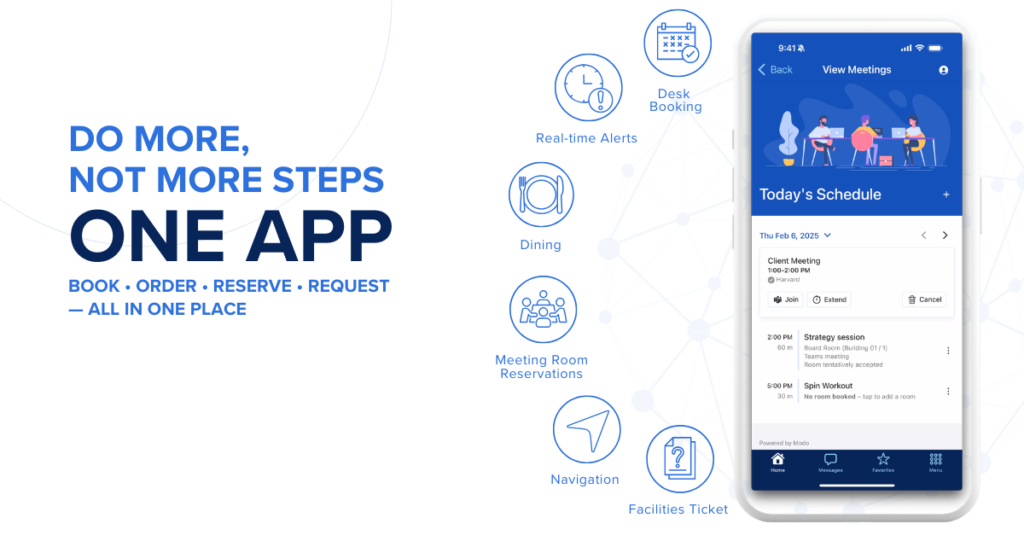
That could mean booking a desk, reserving a room, ordering food, submitting a facilities request, checking office amenities, or finding the right workplace service in a few taps, with AI-powered nudges helping reduce the manual effort employees would otherwise need to put in. A unified platform becomes more valuable as more of those everyday workflows are brought together through workplace app use cases.
The second capability is role-based personalization with flexible access. No two workplace journeys are exactly the same, but the experience should feel consistent. An individual contributor, people manager, workplace services lead, and traveling executive may need different content, tools, or offerings, but they should move through the same intuitive UX.
Nor should the platform assume mobile-only behavior. The better standard is mobile-first, not mobile-only: a single app + portal experience that scales well across phones, tablets, and desktops.
The third capability is useful, governed AI. Recent research on the state of AI and AI value realization points to the same pattern: adoption is expanding, but consistent value still depends on redesigning workflows, not just adding new tools.
In practice, that means AI in the workplace should help employees complete routine tasks faster, make useful recommendations, and reduce friction inside trusted workflows, not sit on top of fragmented systems as a flashy extra.
Driving Adoption and Engagement
A great platform that nobody uses is still a failed investment. That is why adoption is not a launch metric. It is the metric.
In enterprise environments, the people who approve the budget are rarely the people who decide whether the experience becomes part of daily work. That is why executive sponsorship matters, but it is not enough on its own. You also need cross-functional ownership so IT can govern securely while Workplace, HR, Comms, and service teams keep the experience relevant over time.
That relevance usually starts with one sticky use case. Employees need a reason to open the app every day. It might be desk booking, room booking, digital access, lunch ordering, colleague visibility, parking, or service requests. Once that daily utility is established, it becomes much easier to layer in broader employee engagement and service workflows.
Onboarding should reflect that same logic. Show employees how the app helps them save time today, not just what features exist.
Then measure repeat engagement, not vanity metrics. Downloads and launch-day excitement are nice, but popular sections, high-trafficked screens, and recurring actions reveal whether employees are actually using the experience over time. Habit is better.
Measuring Impact and Demonstrating ROI
Enterprises should also expect a unified employee experience platform to make its value legible across the buying group. If the business case only works for one function, it will usually stall.
Different stakeholders care about different proof points. Workplace and corporate real estate teams may focus on utilization, service delivery, or reduced no-shows. HR may look at employee satisfaction, internal sentiment, or friction in onboarding and day-to-day support.
IT may care more about governance, maintainability, reduced support burden, and vendor consolidation. Finance wants the roll-up: time saved, cost avoided, and a clear path to measurable ROI.
That is why the best ROI stories start with friction, not abstraction. How many minutes are employees losing trying to find a desk, locate a colleague, navigate a building, or report a problem? What happens when those minutes are reclaimed across thousands of employees, day after day?
Modo’s own workplace app ROI calculator is built around that practical question, and the value story becomes easier to tell when every stakeholder can see how reduced friction translates into measurable outcomes.
A strong measurement model also tells a story that each stakeholder can repeat upward. IT can talk about lower complexity. Workplace teams can talk about smoother service delivery.
HR can talk about a better digital workplace employee experience. Finance can talk about productivity and consolidation. When those stories align, the platform stops looking like a nice-to-have app and starts looking like enterprise infrastructure.
Preparing for the Future: AI and the Agentic Workforce
The next expectation enterprises should set is about trajectory. A unified employee experience app should not only solve today’s friction. It should give you a realistic foundation for the next wave of workplace automation.
That matters because the future of AI at work is not one chatbot answering generic questions. It is a coordinated task execution inside real workflows. McKinsey’s research on AI in the workplace suggests that most organizations are still early in scaling AI and that redesigning workflows is a key success factor. That is a useful reminder: the path to an agentic workforce starts with connected systems, clean permissions, trusted data, and governance.
A simple example makes this concrete. An employee asks, “Who from my project team is in the office next week, and can I book a desk near them?” That request is not a single lookup.
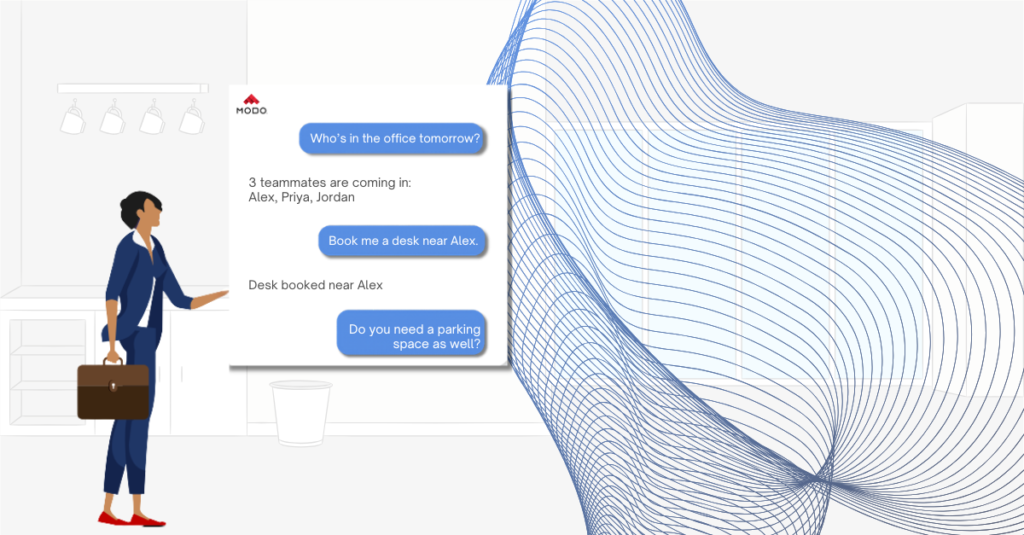
It touches schedules, workplace data, colleague relationships, location logic, booking rules, and permissions. A shallow portal cannot do much with that. A unified experience layer with multi-agent tasking can.
That is the strategic promise. AI should help reduce the number of steps between intent and outcome. It should not replace core systems, nor operate outside enterprise guardrails.
The organizations that benefit most will be those that treat AI as an embedded capability within a useful experience, not as a separate experiment searching for a home. It is also a good moment to reassess whether standalone tools, including space booking technology, are enough on their own.
Transform Your Employee Experience
Enterprise organizations should expect more from a workplace experience app, or a revamped intranet, than notifications, redirects, and surface-level convenience. The right platform should consolidate everyday work moments into one connected experience, reduce app sprawl, make systems easier to use, and create a foundation for governed AI that actually helps employees get things done.
If that is the standard you are aiming for, Modo is built for it: one unified experience layer across app + portal, mobile, and desktop, with actionable integrations, role-based personalization, and a clearer path from friction to measurable value.
Request a demo to see how Modo can unify your employee experience and drive measurable impact.
FAQs
What Is an Employee Experience App, and Why Do Enterprises Need One?
An employee experience app gives employees one place to access workplace services, information, and workflows. Enterprises need one when digital sprawl starts getting in the way of productivity, adoption, and service delivery. The key is choosing an employee experience app that does more than aggregate links.
How Do Unified Employee Experience Platforms Differ From Single-Function Apps?
Single-function apps solve one task well, but they often add to the clutter. A unified employee experience platform brings together multiple daily workflows, supports role-based experiences, and connects to existing systems so employees can move from information to action in one place.
What Outcomes Should Organizations Measure To Determine Success?
Start with repeat usage, task completion, and time saved. Then add the measures each stakeholder needs, such as workplace utilization, service efficiency, employee satisfaction, support burden, vendor consolidation, and broader ROI.
The goal is not just activity. It is a measurable reduction in digital friction.
What Does Gartner Say About Workplace Experience Applications?
Gartner describes Workplace Experience Applications (WEX) as solutions that support a range of work styles and preferences, simplify resource reservation, and automate workplace processes to improve the employee experience.
For enterprise organizations, that reinforces the bigger point: a workplace experience app should do more than centralize information. It should reduce the time employees spend finding workspaces, accessing services, and completing routine tasks so they can stay focused on higher-value work.
That is also why unified platforms matter. When workplace workflows, personalization, and governed AI come together in one experience layer, the platform becomes a practical foundation for productivity, collaboration, and employee satisfaction.