
The legal profession has always thrived on precision, precedent, and professionalism. But when it comes to the workplace, many law firms are breaking with tradition. Five years after the onset of the pandemic, the legal office is undergoing a quiet yet powerful transformation—from a place of obligation to a curated destination that must earn attendance.
This shift isn’t just about hybrid work policies or better coffee (though both still matter). It’s about recognizing that associates, partners, and support staff now view the office through a new lens—one that demands intentionality, support, and experiences that surpass what they get at home.
In our recent webinar, “Rethinking the Workplace for Law Firms,“ expert panelists and legal practitioners shared how the most forward-thinking firms are designing spaces, experiences, and systems that support the modern realities of legal work. What follows are some of the key lessons learned—real-world examples of how law firms are reshaping the workplace to attract top talent, improve collaboration, and stay competitive.
Reimagining Mentorship: Blending In-Person and Virtual Learning
The legal profession has long relied on a mentorship model grounded in shoulder-to-shoulder learning—the kind of nuanced, in-the-moment training that happens through observation, informal interactions, and direct supervision. For many associates , especially in smaller firms, this historically meant learning through a mix of trial-and-error, live feedback, and day-to-day immersion in office life.
But the pandemic prompted a significant and transformative shift. Many law firms, including small and medium-sized ones, quickly adopted digital tools for training, collaboration, and networking. Research from LawNet found that firms now value online collaboration as highly as traditional in-person opportunities for learning and professional development.

That said, the rise of virtual learning hasn’t erased the importance of in-person experiences—it’s simply evolved them. The hybrid workplace has given rise to a blended model, where mentorship and training can be both intentional and flexible. New lawyers still benefit tremendously from in-person moments, especially when it comes to developing soft skills, interpreting nonverbal cues, and absorbing firm culture. But digital platforms now serve as a parallel channel for skills transfer and cross-office learning.
This dual model is becoming not just acceptable, but preferred. Still, over half of U.S. law firms today (51%) prohibit the hiring of fully remote lateral attorneys, signaling an ongoing belief that in-person collaboration is vital—particularly for onboarding and integrating new talent.
In short, the legal sector isn’t walking away from shoulder-to-shoulder learning—it’s reimagining it, weaving in the best of both virtual and in-person to build smarter, more scalable mentorship structures.
Designing for Focus: How Activity-Based Spaces Drive Law Firm Success
Unlike some industries, legal work demands deep concentration. From reviewing contracts to crafting arguments, “heads-down” time is essential to productivity and performance. But law firms are learning that supporting this kind of focus doesn’t mean defaulting to a sea of closed-door offices.
That’s why many firms are embracing activity-based working (ABW)—a flexible model that aligns the physical workplace with the specific tasks being done. It’s not just about design; it’s about operational efficiency and well-being. Examples include:
- Quiet zones allow for uninterrupted focus.
- Semi-private lounges support low-volume collaboration.
- Hot desks and team neighborhoods facilitate fluid teamwork and space sharing.
- Open areas encourage social connection and learning.
These design choices reflect a growing awareness of how the legal profession actually works—supporting everything from high-stakes individual research to dynamic team-based problem solving.
From an operational standpoint, activity-based working enhances:
- Productivity, by reducing errors and distractions.
- Workflow management, through better space-to-task alignment.
- Support staff effectiveness, by optimizing delegation and reducing burnout.
This has real estate implications, too. When paired with building IoT, AI-powered insights, and a workplace app, firms can analyze workflow patterns and space utilization in real time. This strategic approach helps right-size office footprints while reinvesting in spaces and technologies that foster hybrid work, professional development, and meaningful in-person connection.
Learn more about how AI-powered workplaces and apps
are transforming office life in this guide.
As the 2025 Gensler U.S. Legal Workplace Survey highlights, there’s a measurable increase in time spent on learning and connecting—two pillars of a thriving legal culture. The office, reimagined through an ABW lens, becomes more than a place to sit—it becomes a strategic asset for firm success.
Tech That Works: Streamlining the Legal Workplace Without Disruption
In the legal world, adopting workplace technology isn’t about chasing trends. It’s about solving real operational pain—quickly, efficiently, and with minimal disruption. With billable hours on the line, any new tool has to do three things:
- Add value
- Reduce friction
- Eliminate stress
And the stakes? They’re high.

This shift is pushing law firms to simplify and unify their tech ecosystems—consolidating platforms, modernizing systems, and ensuring the digital experience matches the firm’s standards of excellence.
Smart platforms like legal workplace apps are becoming essential in modern law firms, unifying everything from desk and room booking to visitor management and digital ID—all while integrating seamlessly into daily operations. AI is also being introduced strategically, starting with non-billable tasks to free up time and mental energy for higher-value work by associates and partners.
🔎Case Study: A global law firm managing 50+ mobile apps across its international offices turned to Modo to streamline and simplify. By unifying critical workplace features—like room booking, digital ID, ticketing, and space management—into one mobile-first platform, they cut their tech stack in half, accelerated tech rollouts, and created a consistent, scalable experience that supports firm-wide growth. Take A Closer Look

The bottom line: With 71% of legal employers planning to hire for new roles and 99% already struggling to find skilled talent, tech that supports legal work without slowing it down is no longer optional—it’s essential (Robert Half Demand for Skilled Talent).
Attrition rates remain above pre-pandemic levels, and in a market where lawyer unemployment hovers around 1%, retaining top talent is just as critical as attracting it. The right workplace technology helps firms stay competitive, scalable, and attractive to high performers who expect seamless, modern tools that support how they work best.
Creating Five-Star Legal Workplaces: Hospitality-Level Experiences in Law
Frequent travel between offices—both domestic and international—is common in today’s legal landscape. But how do you deliver a seamless, high-quality experience for a lawyer who’s only in an office for one day? Whether it’s a partner visiting London or a new associate onboarding in D.C., the expectation is the same: consistency, quality, and ease.
To meet this demand, forward-thinking firms are reimagining their offices with the same meticulous standards as luxury hospitality brands like Four Seasons or Ritz-Carlton. It’s not just about premium finishes—it’s about delivering a holistic, elevated experience from arrival to departure. Think personalized services, seamless tech support, and workspaces that adapt to individual needs.

Like top hotels, high-performing firms are leveraging data and workplace technology to ensure every touchpoint is intentional and intuitive. The Four Seasons app, for example, empowers guests with convenience and personalization. Similarly, modern workplace platforms enable law firms to offer consistent, tailored experiences—from desk booking to digital IDs—across every location.
This shift toward standardized, premium environments supports productivity, well-being, and a sense of belonging. And it pays off. Emotionally connected individuals are more loyal, more satisfied, and more likely to stay. In fact, emotionally connected customers have a 306% higher lifetime value—staying an average of 5.1 years versus 3.4 for merely satisfied ones.
In an industry where top talent is hard to find and even harder to keep, a high-touch, high-consistency workplace experience is more than a luxury—it’s a retention strategy.
Emerging Roles: A Focus on Operationalizing Engagement and Belonging
Perhaps the most telling sign of this workplace evolution? New roles like Director of Connections are emerging. These aren’t traditional HR or IT roles—they’re designed to bridge people, places, and processes, making workplace experience a deliberate outcome, not a happy accident.
In large, globally distributed firms, this function is becoming essential. Whether it’s called Director of Connections, Legal Operations, Culture and Engagement, or Business Services, the core responsibilities often overlap: developing and implementing firm-wide strategies that foster engagement, maintain morale, and create a sense of belonging—regardless of whether employees are working remotely, on a hybrid schedule, or in-office.
Listening to the voices of your firm—across departments, roles, and locations—is critical. The most effective leaders in these roles don’t just implement programs; they listen deeply to stakeholder feedback to design experiences that reflect the real needs of their people.
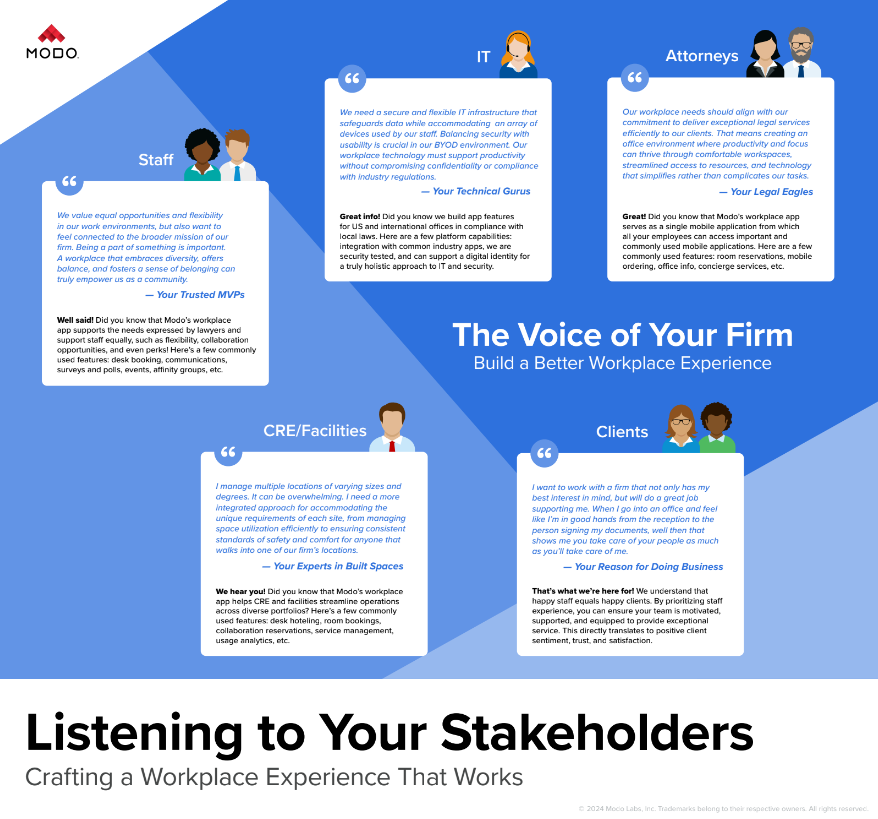
Take Akerman, for example. Their recent publishing of a Director of Connections job role shows how forward-thinking firms are operationalizing experience. This position is tasked with leading initiatives to ensure every team member—attorney or staff—feels connected, trained, supported, and engaged, no matter where they work. It’s a role that interacts directly with the C-suite and collaborates cross-functionally with departments like Operations, IT, Recruiting, and HR, reinforcing how interconnected workplace experience has become.
This role isn’t just about culture—it’s about operationalizing experience through empathy and insight. From onboarding and mentoring to digital engagement and cross-office collaboration, these leaders are charged with aligning technology, people, and space to support a more cohesive and inclusive environment.
As law firms face ongoing challenges around retention, hybrid work, and culture-building, these emerging roles are a signal: the workplace experience needs to be managed with as much precision as client service. Those who invest in this kind of strategic leadership—supported by intentional technology, feedback loops, and connected ecosystems—will be better equipped to attract top talent, deliver consistency across locations, and thrive in a rapidly evolving legal landscape.
Why Workplace Experience Is Now a Talent Strategy for Law Firms
Legal talent is harder to retain than ever. High associate turnover isn’t a temporary trend—it’s a persistent challenge. And it’s one that demands more than compensation packages or ping-pong tables. To stay competitive, firms must invest in the full scope of the employee experience: the right tech, the right space, the right support—and critically, the right balance of flexibility.
As of March 13, 2025—five years since the first wave of COVID-19 disrupted office norms—many associates in large firms have never worked in the office five days a week. Their expectations are different. Their experience of “normal” is different. And their willingness to return to the office hinges not on mandates, but on motivation.
So, what’s the new bar? Simply put: the in-office experience must be better than what employees can get at home. From better coffee and seamless technology to engaging spaces and access to mentors and teammates, the office has to offer value. The experience has to be intentional. It has to feel worth it.
These insights—shared during our recent webinar “Rethinking the Legal Workplace in the Era of Digital Transformation“—highlight a fundamental truth: the legal office isn’t just a physical place. It’s a lever for culture, connection, and competitive advantage.
The workplace must evolve from being a static location into a dynamic ecosystem—one that supports productivity, nurtures professional growth, and reinforces the firm’s values and identity. Offices are now cultural anchors, mentorship hubs, client showrooms, and talent magnets.
To succeed in this new era, law firms must reimagine tradition, not replace it. They must treat workplace experience as a core business strategy, not a background function. Because in a world where people have options, the office must earn its place—not just in someone’s schedule, but in their sense of purpose and belonging. Modo’s platform doesn’t just streamline workflows—it drives adoption and maximizes productivity, ensuring employees have the right tools, the right information, and the right experiences—when and where they need them.