
Key Takeaways
A campus app should do more than send notifications or collect links in one place. The better model is a unified experience layer across mobile and desktop that helps students, faculty, staff, and visitors find what they need and take the next step without bouncing between disconnected systems.
- A true campus app brings services, information, and workflows into one role-aware experience.
- Fragmented apps and portals create friction and confusion at the moments that matter most, from registration and wayfinding to dining, advising, and support.
- Unified experiences improve adoption because users know where to go every day.
- The strongest campus apps move beyond access and into action through integrations, personalization, and governed AI.
- Modo Campus is built as an app + portal experience, not a standalone mobile tool.
If your campus already has a portal, a handful of department apps, an LMS, an SIS, and a dozen places where important information lives, you are not alone. Many institutions have built digital environments one need at a time. The result is usually familiar: more tools, more redirects, more workarounds, and more guessing about where a student is supposed to go next.
That matters because students do not think in systems. They think in moments.
They are trying to check a hold before registration opens, find tonight’s dining options, pull up a class schedule, get directions to an event, message a support office, or figure out what they need to do before a deadline passes. When the digital experience is fragmented, the burden of stitching it together falls on the user.
Why a Unified Campus App Matters
This is the real reason the campus app conversation matters. It is not about adding another shiny front end. It is about reducing digital friction at the exact points where confusion turns into frustration, delay, or disengagement.
On many campuses, the digital journey still feels like a scavenger hunt. A student checks one system for classes, another for assignments, another for events, another for campus maps, and yet another for dining or ID-related tasks.
Even when each tool works fine on its own, the overall experience does not. What looks manageable on an org chart feels messy in real life. Research from EDUCAUSE has highlighted the challenge institutions face in trying to unify the student digital experience.
That fragmentation creates more than inconvenience. It can weaken the sense that the institution is easy to navigate and ready to support students when they need help most. NASPA has highlighted the connection between student belonging and student success, making the digital experience more than a convenience issue. It is part of how students experience support.
A unified campus app changes the standard. Instead of asking users to learn the institution’s system map, it gives them one role-aware place to start. That is why a digital front door only helps if it leads somewhere actionable. Friction is reduced by giving people better access that actually helps them complete the task.
Defining the Campus App
A campus app is a unified digital layer across mobile and desktop that brings together the services, information, and workflows people use every day. It is not just a college mobile app or a digital campus portal. It is the connective experience above those systems that makes them easier to use in context.
That distinction matters because a lot of higher ed tools solve only one problem.
A standalone events app may be useful. A portal that aggregates links may be useful. A student engagement platform that sends reminders may be useful. But if each one stops at communication, navigation, or a narrow workflow, students still end up doing the integration work themselves.
A true campus experience platform should feel more cohesive than that. It should enable a student to move from awareness to action. Not just “you have a hold,” but where to view it and what to do next. Not just “here is an event,” but the ability to RSVP, find the location, and add it to the day’s plan. Not just “here is the dining hall menu,” but a consistent experience that flows seamlessly between schedules, maps, campus life, and services.
That kind of connected experience is what a unified campus app should make possible, whether the task is checking a class schedule, finding dining options, navigating to an event, or accessing support services in context.
It also should not be student-only. A modern university app needs to support the broader campus community through role-based experiences. Students, faculty, staff, families, alumni, prospective & admitted students, and visitors have different needs, and a good campus app respects that without creating a separate digital universe for each audience.
How Unified Experiences Drive Outcomes
This is where the conversation shifts from category language to real outcomes. A unified campus app works because it simplifies one of the hardest parts of campus technology: helping people know where to go, then making it easy to do the thing they came to do.
Adoption improves when there is one obvious destination. That sounds simple, but it is easy to underestimate. If students have to remember which tool handles which task, usage splinters.
If one campus app becomes the reliable starting point, behavior changes. That is part of why app consolidation matters. It gives the campus community one place to return to, which is essential when buyers and end users are not the same people.
Unified experiences also work because they can be personalized by role and driven by actionable integrations. A first-year student may need orientation details, class schedules, dining hours, and campus maps. A faculty member may need advising tools, events, and service requests. A visitor may just need parking and wayfinding. One platform can support those different needs without turning into a maze.
There is an operational upside, too. App sprawl is not just a user problem. It creates duplicated ownership, fragmented support, and more maintenance overhead behind the scenes.
A unified experience layer helps campuses reduce tool fatigue, support a stronger app-consolidation story, and create a clearer path to long-term adoption. That is a better outcome for students and staff, and it’s easier for the institution to manage.
Modo Campus in Action
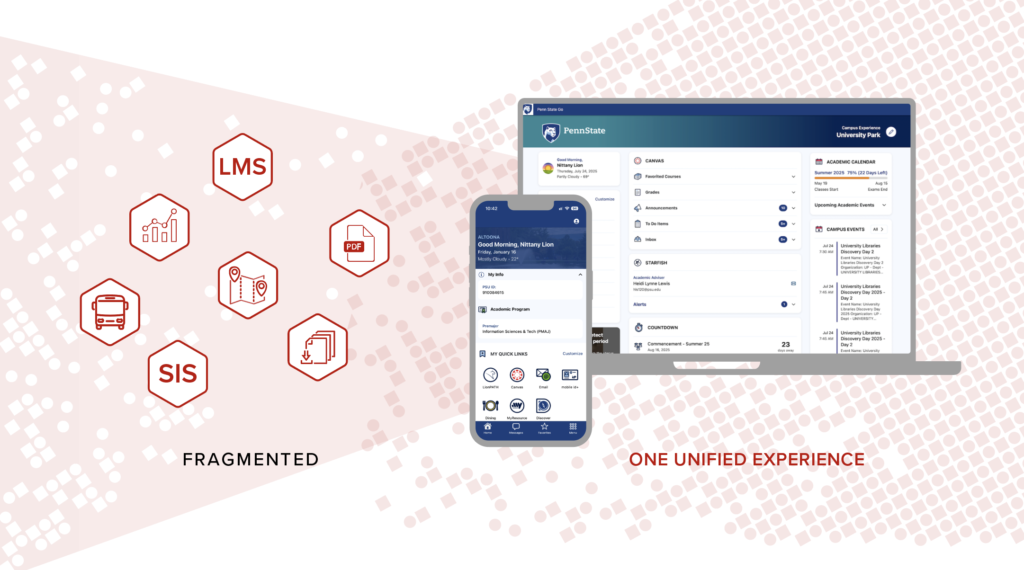
This is where Modo Campus stands apart from a surface-level portal or a notification-heavy app. Modo approaches the campus experience as a connected app + portal delivered across mobile and desktop, with role-based personalization, actionable integrations, and governed AI built to help users move forward, not just surface answers.
Picture a student on a Tuesday morning. They open one campus app to check today’s classes, see an alert about an advising task, pull up directions to a building they have never visited, review dining options between classes, and tap into a support service after lunch. They are not thinking about which backend system owns each moment. They are just getting through the day with fewer dead ends.
That same model works on the operational side as well. Governance can stay centralized while ownership is distributed safely. IT does not have to own every update forever, because the right campus teams can manage the parts of the experience they know best. That helps the platform stay useful after launch, rather than turning into a static project that looked good on day one and faded after.
For campuses thinking about long-term strategy, the more useful question is not whether to launch another standalone tool. It is whether the institution wants a broader campus app-building strategy that supports ongoing adoption, role-based usefulness, and measurable value over time.
Take Action With a Unified Campus App
A campus app should not be another point solution in an already crowded stack. It should be the place where your campus experience becomes easier to navigate, use, and evolve. That means one branded app + portal experience that helps users move from information to action, while leaving your core systems in place behind the scenes.
If you are evaluating what that could look like at your institution, explore Modo Campus and see how a unified experience layer can simplify the day-to-day experience for students, staff, and the broader campus community.
Request a demo today to see how Modo Campus can simplify your campus experience.
FAQs
What Is a Campus App?
A campus app is a unified digital layer that brings campus services, information, and workflows into one connected experience across mobile and desktop. It is broader than a single-purpose university app because it can connect schedules, events, dining, maps, digital ID, communications, and support services in one place.
How Does a Campus App Differ From a Student Portal or Student Engagement Platform?
A student portal often improves access to information, and a student engagement platform often improves communication. A campus app should do both, but it should also help users take action.
That is the difference between a link farm and a unified experience. The stronger model connects app + portal experiences, supports role-based personalization, and brings workflows closer to the point of need.
What Outcomes Should a Campus App Deliver for Students and Staff?
The right outcomes are adoption, repeat usage, easier task completion, lower digital friction, and a clearer path to support. For institutions, that can also mean fewer disconnected tools, better visibility into engagement patterns, and stronger support for retention and student success.