
Key Takeaways
Higher education AI is getting real, but the winning model is not another disconnected tool. It is an AI embedded inside a unified campus app + portal experience that helps students move from question to action.
- Why fragmented campus systems make AI more urgent, not less.
- How AI can improve student engagement through role-based, actionable support.
- What it takes to make SIS, LMS, and service systems feel invisible to students.
- How campuses can evaluate AI without creating a new layer of digital friction.
Students do not wake up thinking about your SIS, LMS, help desk, financial aid portal, or advising workflow. They wake up thinking, “Can I register?” “Where do I go?” “What am I missing?” “Who can help me?”
The problem is that most campuses still answer those questions through a maze of systems, logins, redirects, and departmental handoffs.
That is why higher education AI matters right now. AI is already becoming part of how students learn and seek support, and student use is widespread and rising fast.
The real opportunity is not to add one more chatbot to the pile. It is to redesign the student experience so that answers, next steps, and actions are all in one place.
Why AI Matters for the Modern Campus
This shift matters because student experience is now shaped by digital friction as much as by the quality of services themselves. A campus can have strong advising, robust financial aid support, and good academic resources, but if students have to hunt across five destinations to use them, the experience still feels broken.
That fragmentation is exactly where many campus AI efforts get stuck. EDUCAUSE’s Higher Education AI Readiness Assessment is built around strategy, governance, technology, workforce, and teaching and learning, which is a useful reminder that AI maturity is not just a tooling question.
Ithaka S+R has also found that AI literacy and policy efforts are often siloed across institutions, with departments developing separate approaches and few campuses managing truly institution-wide initiatives.
The stakes are not just about convenience. Retention is still a hard-number issue for colleges and universities.
The National Student Clearinghouse Research Center reports that the national second-fall retention rate for the 2023 cohort was 69.5% in its Persistence and Retention report. When a registration hold, missed deadline, or unanswered support question turns into a stop-out risk, better navigation is not enough.
So, what should campuses actually want from AI? Not AI that simply recites information faster.
The better standard is AI embedded in the experience layer, where it can surface the right answer, understand who the student is, and help them take the next step in context. That is the difference between a campus AI strategy that reduces friction and one that quietly creates more of it.
How AI Enhances Student Engagement
Student engagement is the practical test for any campus technology investment. If students do not return to it, trust it, or use it when something important is on the line, the platform may look modern, but it is not doing enough to change outcomes.
AI starts to matter when it becomes personal, role-based, and timely. A first-year student may need help understanding orientation tasks, registration readiness, and basic campus services. A senior may need quick access to degree progress, internship resources, and financial deadlines.
A useful AI-enabled campus experience does not treat those as identical journeys. It recognizes role, context, and urgency, then responds accordingly.
That also means moving from communication to action. A surface-level portal can notify a student that something needs attention. A stronger campus app + portal experience can help them resolve it in the same flow, whether that means checking a hold, seeing what documents are missing, finding the right office, or understanding what to do before registration opens. The point is not just access. It is completion.
Modo My Agent Embedded AI
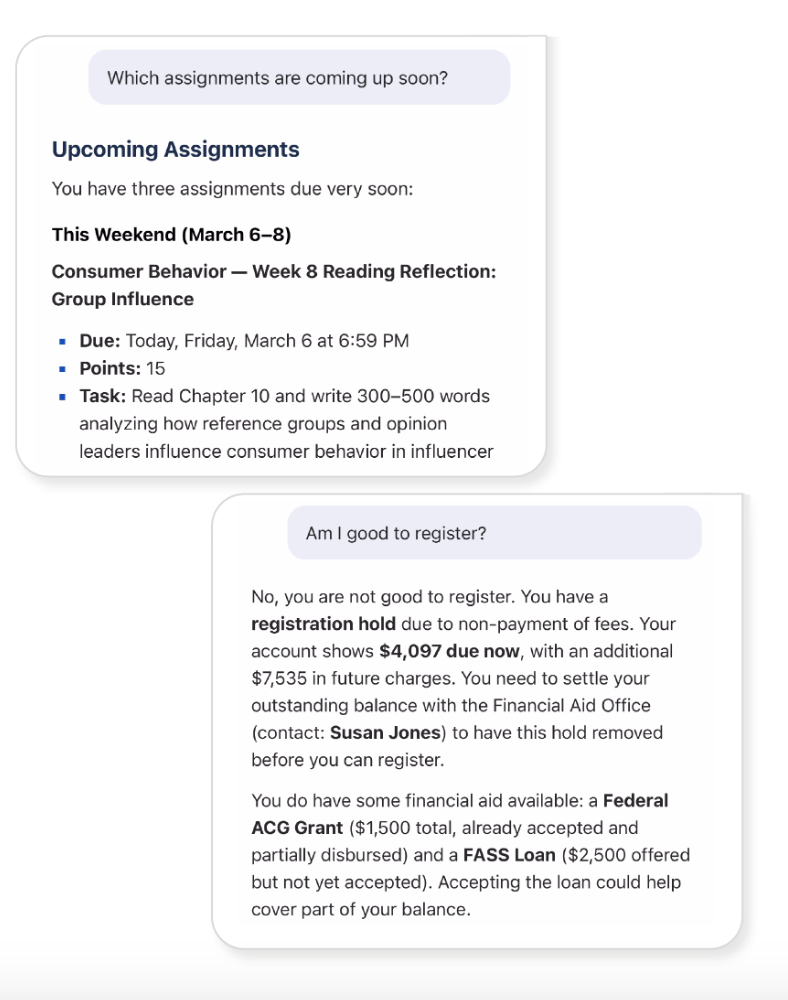
There is already proof that students respond when AI is built this way. At UA–Pulaski Technical College, Modo’s embedded AI agent became the most-used feature in the campus experience, reaching 94.5% student adoption and driving a 253% increase in app engagement.
The result matters because it reflects the metric that matters most: students actually used it. That same pattern shows up at Illinois State University, where AI became more useful after the university had already unified access to core systems and services, rather than treating AI as a separate destination.
Making Campus Systems Invisible With AI
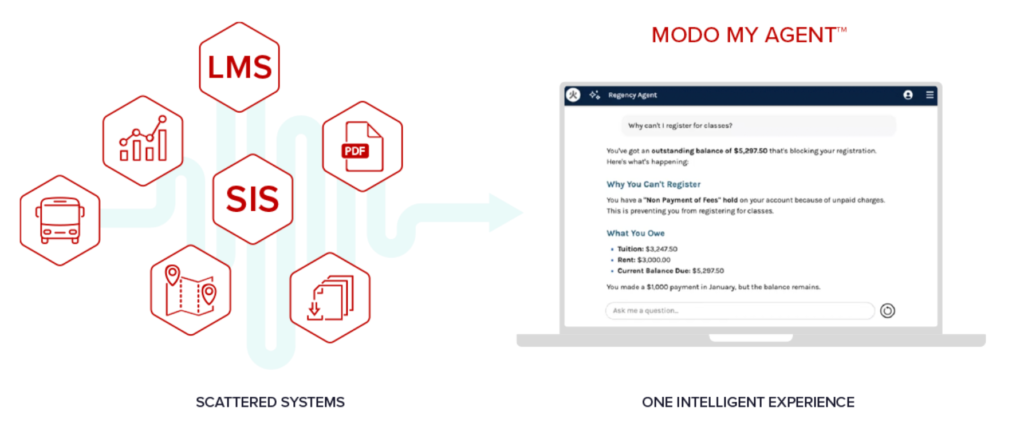
This is where architecture matters. If you want AI to improve the student experience, it cannot exist in a silo as a separate destination. It has to sit inside the experience students already use, where institutional systems can stay in the background, and the task at hand stays in the foreground.
That is why the most promising higher ed AI models are not single-system or single-domain chatbots. They sit above them as a unified experience layer.
In practical terms, that means students can move across academic information, campus services, support resources, and institutional workflows through a single branded app + portal on mobile and desktop, instead of having to understand which backend owns each action.
Mobile-first, not mobile-only, also matters more than many campuses admit. Students may start a task on a phone while walking across campus, then finish it on a laptop later that night.
A campus AI experience that breaks between devices creates a new kind of friction. A governed, consistent app + portal model is stronger because it preserves context while maintaining institutional control over permissions, data access, and approved sources.
It began by consolidating access to core systems and campus services into one platform, then layering AI on top so students could ask questions conversationally and receive more personalized, actionable support. That is a smarter model for campus AI because it builds on a connected foundation rather than asking AI to compensate for disconnected systems.
What Campuses Should Look for in Higher Education AI
The market is filling up with tools that promise speed, automation, and personalization. The harder question is whether those tools reduce digital friction or simply make fragmentation feel more polished.
Start with actionable integrations. An AI student engagement platform is only as useful as the systems and content it can actually work with. If it cannot connect to trusted institutional data, respect user roles, and trigger real next steps, then it will stop at summaries and suggestions. That may still be useful, but it is not the same as helping a student get something done.
Next, look for governance without bottlenecks. Campuses need IT and security teams to maintain control, but they also need departments such as student affairs, advising, communications, and enrollment to shape the parts of the experience they own.
The strongest model is not centralized chaos or decentralized sprawl. It is governed by flexibility, allowing ownership to be distributed safely, and the experience continues to improve after launch.
Finally, start where the value is obvious. Many campuses will begin with FAQs, knowledge bases, deadline guidance, or support triage. That is often the right move.
The point is to start with high-frequency, low-friction use cases, then expand into deeper workflows like registration readiness, financial guidance, service requests, or personalized nudges once the foundation is proven. That is how campus AI turns from a pilot into a practical operating model.
The Next Standard for Student Experience
The future of higher ed AI is not a smarter search bar, nor is it a chatbot bolted onto a link farm. It is a unified experience layer that helps students know what matters, decide what to do next, and act without bouncing across disconnected systems. That is the real shift: from information retrieval to guided action.
Modo’s approach to campus AI is built around that standard, bringing answers, actions, and personalized guidance into one connected campus app + portal experience. Modo was also recognized as a 2025 AWS EdTech Champion for transforming student engagement with scalable AI.
Discover how Modo’s AI-enabled campus solutions can transform your student experience, and request a demo.
FAQs
What Is Higher Education AI, and How Is It Different From Traditional Campus Technology?
Higher education AI refers to AI-powered capabilities that help campuses personalize support, surface answers, guide decisions, and increasingly assist with task completion.
Traditional campus technology usually gives students access to systems or information. AI changes the model when it is embedded into the experience layer and can help students move from “Where do I find this?” to “Help me do this.”
How Does AI Improve Student Engagement and Retention?
AI improves engagement by making support easier to use in the moments that matter, such as registration, financial aid questions, service requests, and academic planning.
It improves retention potential by reducing missed steps, shortening time to answer, and helping students move from confusion to action faster. That does not replace advising or support teams, but it can make those services easier to access and act on.
What Should Campuses Look for When Evaluating AI Solutions for Students?
Look for four things: trusted integrations, role-based personalization, governance, and actionability. A good solution should work across your existing systems, respect permissions and approved data sources, support both mobile and desktop experiences, and help students complete real tasks rather than stop at generic answers. That is what separates a useful campus AI strategy from another disconnected point solution.