
At your average institution, delivering timely, personalized student support often feels like chasing the impossible. Staff are stretched thin, students struggle to find answers across disjointed systems, and institutional websites, while full of information, can be overwhelming to navigate. For first-generation, part-time, or nontraditional learners, the result is confusion, frustration, and disengagement.
That’s where AI is already making a difference.
By using generative AI to streamline access to information, reduce staff burden, and personalize the student experience, colleges and universities can finally bridge the gap between intention and impact. But while many schools are still figuring out how to bring AI into their ecosystem, one community college is already showing what success looks like.

So–
What happens when you give students 24/7 access to support, right in the palm of their hand? At the University of Arkansas – Pulaski Technical College (UA-PTC), the result has been nothing short of extraordinary.
24/7 Support in the Palm of Their Hands
In partnership with Modo Labs, UA-PTC recently launched MyAgent, a generative AI-powered agent built directly into their mobile app. And in just a few short weeks, it’s already become the app’s most-used feature.
Why? Because it’s fast, intuitive, and actually helpful.
Built using Amazon Bedrock and tightly integrated with UA-PTC’s campus systems, MyAgent delivers instant, personalized answers to student questions—everything from registration deadlines to financial aid guidance. No more waiting in lines or navigating complicated websites. Just ask, and MyAgent responds with verified information, any time of day.
Let’s Talk Numbers — Real Impact, Real Fast
The results at UA-PTC speak volumes—and what’s most impressive is how quickly they’ve materialized. Since launching MyAgent in March, the college has seen a 253% year-over-year increase in unique visitors to Enrollment & Admissions content within the app. Interest from prospective students is also soaring, with views to the “Future Student” persona up 140%, showing that students are turning to the app for guidance as they navigate enrollment.
And it doesn’t stop there—students are relying on the MyAgent for essential financial information too. Views to Financial Services content have climbed 13% in-app and 29% on the UA-PTC website. Thousands of questions have already been answered by MyAgent, offering students real-time clarity and giving staff time back in their day.
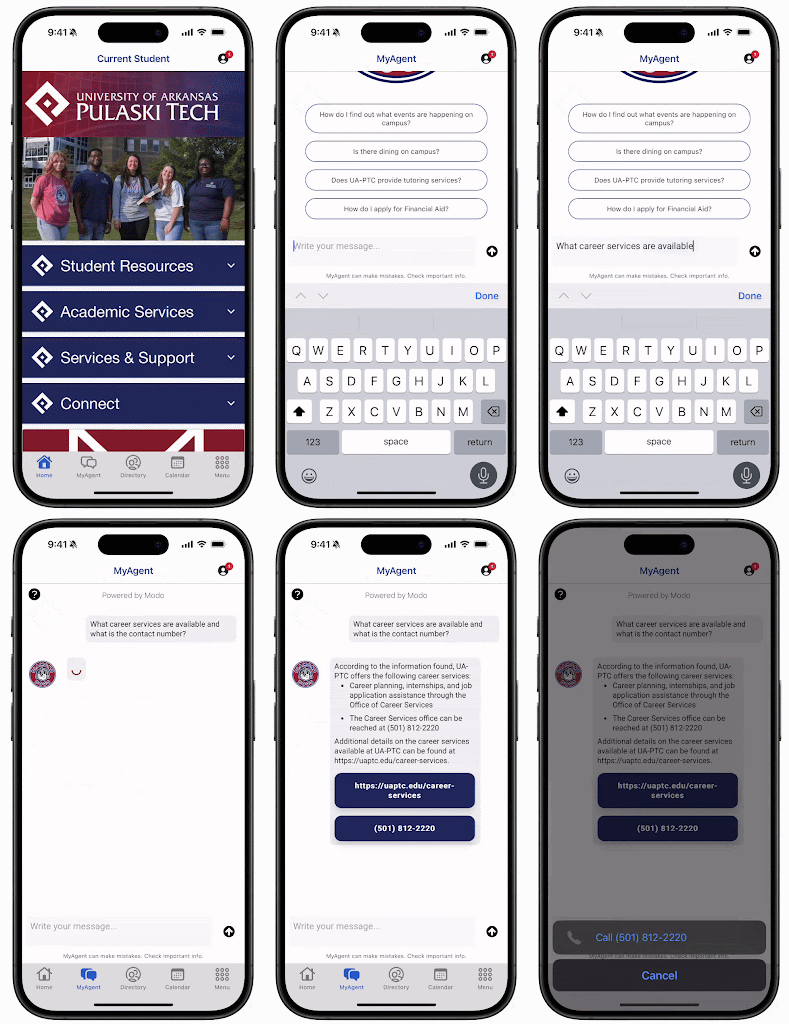
This isn’t just a tech upgrade. It’s a reimagining of student support.
“We’re proud to be among the first community colleges to leverage generative AI in this way,” said Dr. Summer DeProw, Chancellor of UA-PTC. “MyAgent is already transforming how our students access information—anytime, anywhere.”
Start Small, Move Fast: 6 Tips from UA-PTC
When it comes to transforming the student experience, few do it with the clarity and momentum of the University of Arkansas – Pulaski Technical College (UA-PTC). In our recent webinar, the UA-PTC team gave us a powerful look into how her team is reimagining engagement and driving innovation across campus. Here are five key takeaways that showcase their approach:
1. Just Get Started – But Start Thoughtfully
Getting started with AI can often be the most challenging step for campuses, as it requires navigating uncharted territory, addressing concerns around data, and overcoming internal hesitation. Many institutions struggle with where to begin and how to integrate AI responsibly into their existing systems. However, those schools that take the leap early by experimenting, learning, and iterating are the ones to get ahead on the technology curve. By embracing AI now, they position themselves to unlock new efficiencies, improve student experiences, and stay competitive in an ever-evolving educational landscape.
However, a project as robust as new technology still takes planning and strategy. Before UAPTC launches any new tool or redesigns any service, they begin by walking through the student journey—literally. The UA-PTC team mapped out their student experience, from application to graduation, identifying friction points that disrupt learning or cause frustration. This process led to key discoveries: students were unaware of the services and funding available to them, unsure of the necessary steps to degree completion, and overwhelmed by multiple campus communication channels. By anchoring every project from the student perspective, UAPTC ensures that innovation always leads to meaningful improvements, not just flashy upgrades.
2. Audit Your Content Before Launch
One of the unexpected but valuable lessons UAPTC learned early in their AI journey was the importance of accurate, up-to-date content. When their AI-powered agent began pulling information from the college catalog and student handbook, it quickly exposed outdated policies, broken links, and inconsistent messaging. What began as a technical implementation turned into an impromptu content audit, highlighting just how critical it is to maintain clean, reliable documentation. As the team worked to correct and update their materials, they not only improved the AI’s performance but also enhanced the overall student experience. Their advice to peers: before you launch, double-check your content. It’s a simple step that can save you a lot of time and confusion down the road.
Lennon Parker, the school’s Webmaster and App Manager, emphasized the importance of simply diving in:
“Just do it… we just jumped into it,” he said. But he also cautioned that the team quickly discovered gaps in their existing documentation. “One of the first things I would recommend—make sure the content you’re using is correct.” The AI agent at UAPTC pulled information from the catalog and student handbook, revealing outdated policies and links. That unexpected audit ultimately led to cleaner, more accurate institutional content, but it was a lesson learned in real time.
3. Expect Imperfection, Then Improve Together
A lean internal innovation team can lead the charge in testing ideas, launching pilots, and scaling what works. But true transformation happens when innovation is embraced across departments and driven by real-time student feedback. At UAPTC, the innovation mindset isn’t limited to one office—it’s a campus-wide commitment. Faculty, staff, and leadership are encouraged to think like problem-solvers, and their ideas are not only welcomed but also implemented. Dr. DeProw emphasized that “we’re all innovators,” a mindset that fuels a culture of continuous improvement. This approach ensures that updates—whether to the website, enrollment process, or AI agent—are shaped by what students actually need and say. Cross-functional collaboration and responsiveness to feedback allow the institution to iterate quickly, ensuring every department plays a role in driving meaningful change.
Whether it’s redesigning the college website or streamlining enrollment, innovation is seen as everyone’s responsibility, and that collective ownership accelerates transformation. With cross-functional representation and a direct line to leadership, they’re able to move fast, learn quickly, and maintain momentum.
4. Shift the Campus Mindset: See AI as an Ally, Not a Threat
Encouraging the campus community to view AI as a helpful tool rather than something to fear is crucial for the successful adoption of AI. Wayne Floyd, CIO at University of Arkansas – Pulaski Technical College, emphasizes that much of the resistance to AI comes from uncertainty about what it can do and concerns about misuse. However, when approached thoughtfully, AI becomes a powerful ally, streamlining access to information, saving students valuable time, and reducing frustration. By starting with simple, practical use cases that demonstrate benefits, institutions can build trust and confidence in AI technologies. This mindset shift allows campuses to unlock AI’s full potential as a resource that supports both students and staff, rather than seeing it as an unknown risk.
Wayne urged institutions not to fear AI, noting its role in making information more accessible and saving students time, “From a CIO standpoint. I know that there are people out there who adamantly say no to AI, because they don’t know what it can do. They don’t know how people are going to use it, how people are going to try to manipulate it.”
“But in this instance we’re using it to give people access to information easily that they don’t have to go spend hours digging for…Then it allows you to build your confidence towards that AI.”

5. Translate the Institution into Student Language
DeProw also praised MyAgent’s ability to bridge the gap between academic jargon and everyday student language. This ability to translate complex academic language into everyday terms that students use is monumental for students with questions, resulting in more degree completion. For example, while the official program might be listed as “Tractor Trailer Operations,” students are more likely to search for “commercial truck driving” or simply “truck driving.” This translation helps remove barriers caused by confusing or technical terminology, making it easier for students to find the programs and resources they need. By speaking the students’ language, the AI agent enhances accessibility and supports student persistence by connecting them with relevant information quickly and clearly.
6. Build Trust Through Secure, Ethical Design
When deploying AI on campus, trust is non-negotiable. As Harsh Paleja, VP of Product at Modo Labs, explained, success starts with a strong foundation of ethical design and data integrity. “We run by a few principles: consent-first design, secure infrastructure, and tight institutional controls,” he said. At UAPTC, that meant the college maintained complete control over what information the AI agent could access and how it was used. This level of transparency and oversight not only safeguarded student data but also ensured the agent functioned as a trusted, mission-aligned tool—not a risk. By prioritizing privacy from day one, UAPTC was able to foster both user confidence and institutional buy-in.
A Glimpse Into the Future
MyAgent is just the beginning. UA-PTC’s leadership is already looking at how generative AI can support broader student success goals—whether that’s nudging students toward key milestones, helping them navigate financial aid and course registration, or supporting holistic well-being.
By combining trusted campus data with real-time guidance and conversational ease, AI agents like MyAgent have the power to meet students where they are and move them forward. With MyAgent, they’re not just catching up to digital transformation—they’re leading it.
So, what could your campus look like with this kind of intelligent automation at its core?
The bar for student support has officially been raised—and it’s powered by AI.
👉 Want to see how it works? Learn more about MyAgent and Modo’s AI tools here.
Curious how a two-year college launched an AI agent in just weeks—and made it their most-used student support tool?
Watch our latest webinar with the University of Arkansas – Pulaski Technical College, Modo, and AWS to see how they built MyAgent to deliver 24/7 support, drive student adoption, and lighten staff workload—without rebuilding their systems.
You must be logged in to post a comment.